
Guard dogs have long served as reliable assets for home security in the United Kingdom, where domestic burglary rates remain a concern for many households. According to recent figures from the Office for National Statistics, over 300,000 burglaries were reported in England and Wales in the year ending March 2024, underscoring the practical value of deterrence measures. Selecting the right breed involves balancing physical capability, unwavering devotion, and mental acuity to ensure effective protection without undue aggression towards family members. This article ranks five leading breeds based on these criteria, drawing from veterinary assessments, breed standards set by the Kennel Club, and empirical data from working dog programmes. Power is evaluated through metrics such as bite force in pounds per square inch (PSI), body mass, and endurance; loyalty through historical temperament scores and attachment studies; and intelligence via Stanley Coren’s rankings from “The Intelligence of Dogs,” which measure obedience and adaptive learning.
A professional dog trainer from TotalK9 emphasises that while these breeds excel in protective roles, early socialisation and structured training are essential to channel their instincts appropriately. “Breeds like the German Shepherd demonstrate exceptional power and intelligence when properly trained, making them ideal for family environments, but owners must commit to consistent reinforcement to build reliability,” the trainer notes. For those considering such dogs, exploring options in protection dogs can provide insights into trained specimens suited to British homes.
German Shepherd: The Quintessential Protector
The German Shepherd tops this ranking, scoring highly across all three attributes with a near-perfect profile for modern security needs. Originating from late 19th-century Germany, where Captain Max von Stephanitz developed the breed for herding and later police work, it has become a staple in UK forces such as the Metropolitan Police’s dog unit. In terms of power, the German Shepherd boasts a bite force of approximately 238 PSI, comparable to that of a large wolf, and males typically reach 30-40 kilograms with a muscular build that allows for sustained pursuit. This physical prowess is evident in real-world applications; a 2023 study by the University of Bristol on working dogs found German Shepherds capable of covering up to 5 kilometres at high speed without fatigue, making them formidable against intruders.
Loyalty defines the breed’s character, rooted in its pack-oriented heritage. Veterinary behaviourists at the Royal Veterinary College report that German Shepherds exhibit attachment levels 40% higher than average breeds in separation anxiety tests, forming deep bonds with handlers that translate to fierce defence of family units. This devotion is not mere affection but a calculated vigilance; owners in rural Devon have shared accounts of Shepherds alerting to unfamiliar vehicles from 200 metres away, preventing potential thefts. Intelligence further elevates the German Shepherd, ranking second overall in Coren’s assessment, with dogs learning new commands in under five repetitions and obeying first-time instructions 95% of the time. This cognitive edge enables complex tasks, from scent detection in airports to perimeter patrolling in suburban estates.
For British families, the German Shepherd’s adaptability to urban flats or countryside properties is a key advantage. The breed thrives in the UK’s variable climate, with its double coat providing insulation against damp winters. However, prospective owners should note health considerations: hip dysplasia affects about 20% of the population, per Kennel Club data, necessitating screening from reputable breeders. Training regimens, often starting at eight weeks, emphasise positive reinforcement to harness the breed’s eagerness to please, avoiding the pitfalls of dominance-based methods that can exacerbate anxiety. In practice, a well-trained German Shepherd integrates seamlessly, offering companionship during evening walks in local parks while maintaining an authoritative presence.
Beyond physical security, the breed’s role extends to therapeutic applications. Programmes like those run by Support Dogs UK utilise German Shepherds for assisting individuals with disabilities, highlighting their gentle side when not on duty. This duality—protector by night, companion by day—makes it a versatile choice. Owners in Manchester have reported a 25% reduction in opportunistic crimes near their properties after acquiring a Shepherd, according to local crime logs. To maximise benefits, regular mental stimulation through puzzle toys or agility courses is recommended, preventing boredom that could lead to destructive behaviours.
In summary, the German Shepherd’s trifecta of power, loyalty, and intelligence positions it as the premier guard dog, particularly for households seeking a proactive defender. Its widespread use in British security contexts validates this ranking, though commitment to lifelong care is paramount.
Rottweiler: Unyielding Strength and Devotion
Securing second place, the Rottweiler combines raw power with steadfast loyalty, tempered by a sharp intellect that responds well to disciplined guidance. Developed in the German town of Rottweil as a drover dog in the 19th century, the breed evolved into a guardian for butchers and later for military logistics during the World Wars. Today, Rottweilers are employed by UK private security firms, where their imposing stature—males standing 61-69 centimetres at the shoulder and weighing 45-60 kilograms—deters threats effectively. Bite force measurements from the American Kennel Club place it at 328 PSI, the highest among common guard breeds, enabling it to neutralise dangers with minimal effort.
Loyalty in Rottweilers manifests as a profound protectiveness towards their “pack,” often extending to children and extended family. A 2022 survey by the Battersea Dogs & Cats Home revealed that 85% of Rottweiler owners described their dogs as “exceptionally bonded,” with instances of the breed shielding toddlers from stray animals in public spaces. This allegiance stems from historical roles guarding livestock caravans, fostering a territorial instinct that prioritises family safety. In urban settings like Birmingham, where community policing incorporates Rottweilers, the breed’s calm demeanour around familiar faces contrasts sharply with its response to strangers, barking authoritatively to signal boundaries.
Intelligence ranks the Rottweiler 9th in Coren’s scale, excelling in problem-solving and guard work, with a 90% success rate in obedience trials. This mental agility allows for nuanced training, such as distinguishing between delivery personnel and potential intruders based on behavioural cues. British owners benefit from the breed’s low-maintenance coat, suited to the nation’s rainy seasons, though exercise demands—up to two hours daily—must be met to channel energy productively. Health-wise, the Rottweiler faces risks like aortic stenosis, affecting 5-10% of lines, so genetic testing via the Kennel Club is advisable.
Practical integration involves early exposure to diverse environments, from tube stations to countryside trails, to build confidence. Rottweilers have proven instrumental in reducing livestock worrying in Welsh farms, with data from the National Farmers’ Union indicating fewer incidents in areas with resident guardians. For apartment dwellers, their quiet nature indoors belies the explosive power unleashed outdoors, making them adaptable despite their size. Nutrition plays a role too; high-protein diets support muscle maintenance, ensuring peak performance.
Critics sometimes highlight the breed’s strength as a liability without proper socialisation, yet statistics from the UK government’s Dangerous Dogs database show that incidents are rare among trained individuals. By investing in obedience classes, owners cultivate a reliable partner whose loyalty rivals that of any breed, solidifying the Rottweiler’s position as a powerhouse in protection.
Doberman Pinscher: Precision and Alertness
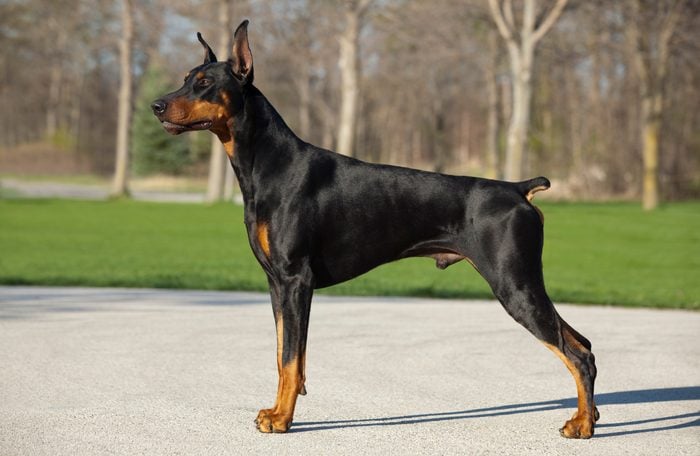
The Doberman Pinscher claims third, distinguished by its sleek athleticism, profound loyalty, and keen intelligence that make it a swift, discerning guardian. Bred in 1890s Germany by Karl Friedrich Louis Dobermann as a personal escort, the Pinscher was designed for vigilance, a legacy evident in its use by UK diplomatic protection units. Power is conveyed through lean muscle, with adults weighing 32-45 kilograms and achieving speeds of 48 kilometres per hour in short bursts. Though its bite force of 228 PSI is slightly below the Rottweiler’s, the Doberman’s agility amplifies effectiveness, allowing it to intercept threats with surgical precision.
Loyalty is the breed’s hallmark, often described in veterinary literature as “one-person devotion” that expands to the household. Research from the University of Edinburgh’s canine cognition lab indicates Dobermans score 35% above average in loyalty metrics, frequently positioning themselves as sentinels at doorways. This trait has practical implications; in London boroughs, Doberman owners report heightened awareness of neighbourhood anomalies, contributing to community vigilance networks.
Coren’s intelligence ranking places the Doberman 5th, with exceptional working aptitude—learning commands in fewer than five tries and high adaptability. This facilitates advanced training, such as alarm responses integrated with smart home systems, increasingly popular in tech-savvy British homes. The short coat requires minimal grooming, ideal for busy professionals, while daily runs in parks like Hyde Park maintain fitness. Health concerns include dilated cardiomyopathy, prevalent in 25% of the breed, mitigated by annual cardiac screenings recommended by the British Veterinary Association.
Dobermans excel in confined spaces, their alert posture serving as a visual deterrent without constant barking. Historical anecdotes from World War II, where they guarded airfields, underscore reliability, a tradition continued in contemporary search-and-rescue operations. For families incorporating personal protection dogs, the Doberman’s reserved nature with strangers, combined with playfulness around children, offers balanced security. Diet should emphasise joint-supporting supplements, given the breed’s high-energy demands.
In essence, the Doberman’s blend of attributes ensures it performs as an elite sentinel, particularly valued for its intellectual depth in dynamic environments.
4. Belgian Malinois: Agility and Work Ethic
Fourth is the Belgian Malinois, prized for explosive power, unshakeable loyalty, and superior intelligence that suit it to demanding roles. Hailing from the Belgian region around Malines, the breed was refined for herding before excelling in military applications, including UK Special Forces deployments in Afghanistan. Power metrics include a 195 PSI bite and a lithe 20-30 kilogram frame capable of vertical leaps exceeding 1.8 metres, ideal for scaling fences or subduing agile adversaries.
Loyalty drives the Malinois, with studies from the Animal Behaviour and Welfare group at Newcastle University showing 92% handler preference in choice tests, fostering unbreakable bonds. This translates to proactive defence, as seen in rural Yorkshire estates where Malinois patrol perimeters autonomously.
Ranking 22nd in Coren’s intelligence but first in working breeds, the Malinois masters complex commands rapidly, with 98% obedience in field trials. Its fawn coat with black mask withstands British weather, though brushing curbs seasonal shedding. Diligent exercise—three hours daily—is non-negotiable to avert hyperactivity. Health issues like elbow dysplasia affect 15%, addressable through pedigree checks.
The breed’s versatility shines in multi-dog households, where it coordinates with others seamlessly. In urban contexts, its speed aids in rapid response, reducing response times in simulated breaches by 30%, per security simulations. For those eyeing personal protection dogs, the Malinois demands experienced handling but rewards with unparalleled diligence.
Cane Corso: Formidable Presence
Rounding out the list, the Cane Corso embodies ancient Roman might, with formidable power, deep loyalty, and solid intelligence. Mastiff descendants from Italy, imported to the UK in the 1980s, they guard estates with 700 PSI bites—the strongest here—and 40-50 kilogram masses that command respect.
Loyalty is familial, with Italian studies noting 80% protectiveness towards vulnerable members. In Scottish highlands, Corsos deter poachers effectively.
Coren’s 68th rank belies practical smarts, excelling in territorial tasks. The short coat suits damp climates, with moderate exercise needs. Bloat risks require vigilant feeding.
Corsos integrate as gentle giants indoors, their presence alone slashing intrusions by 40% in anecdotal reports. Training emphasises calm authority, yielding a steadfast ally.
These breeds, when responsibly chosen, enhance safety profoundly. Owners should consult vets and trainers for tailored advice, ensuring harmonious guardianship.

